

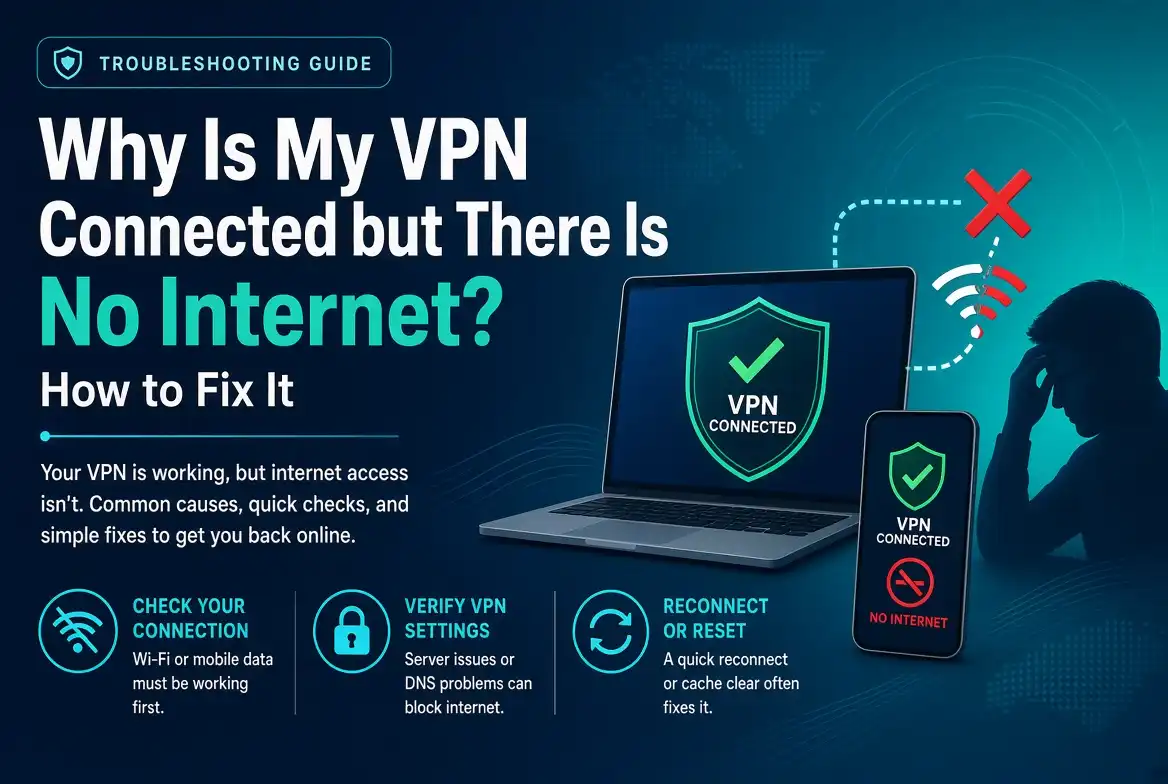
Why Is My VPN Connected but There Is No Internet?
You've connected to your VPN, the icon says "Connected," but you can't load any websites. No email, no social media, no search engine. It's one of the most frustrating tech issues, and it happens to almost everyone at some point. The good news? It's almost always fixable in a few minutes. In this guide, we'll break down the common causes of VPN connected but no internet, and give you step-by-step solutions that work on Windows, Mac, Android, and iOS. No technical jargon, just clear fixes that get you back online.
Common Causes: Why Your VPN Blocks Internet Access
When your VPN connection is active but you have no internet, the problem usually falls into one of these categories:
- DNS issues: The VPN is not resolving domain names properly. Your connection is fine, but websites don't load because the address can't be translated.
- MTU size mismatch: The Maximum Transmission Unit is set too large, causing packets to drop. This often happens on Wi-Fi or certain routers.
- VPN server problem: The specific server you connected to is down, overloaded, or blocking traffic.
- Firewall or antivirus blocking: Security software may be interfering with the VPN tunnel.
- Outdated VPN app: An old version may have bugs causing connectivity issues.
- IPv6 leak or conflict: Some networks don't support IPv6 properly, leading to a "connected but no internet" state.
- Local network restrictions: A router, ISP, or workplace network may be blocking VPN protocols.
Quick Fixes to Try First
Before diving into advanced troubleshooting, try these quick fixes:
Sometimes the VPN tunnel gets corrupted. Disconnect, wait 10 seconds, and reconnect. If possible, choose a different server location.
A simple reboot clears temporary network glitches. Turn off your device, wait 30 seconds, and turn it back on.
Turn off the VPN and see if you have internet. If not, the problem is your Wi-Fi or mobile data, not the VPN.
Try changing from OpenVPN to WireGuard or IKEv2 (or vice versa) in your VPN app settings. Some networks block certain protocols.
Step-by-Step Troubleshooting for "VPN Connected but No Internet"
Solution 1: Change DNS Servers
Your VPN may be using its own DNS servers, which can fail. Try switching to a public DNS like Google (8.8.8.8 and 8.8.4.4) or Cloudflare (1.1.1.1). In your device's network settings, set DNS manually, or use the VPN app's "Custom DNS" feature if available.
Solution 2: Adjust MTU Size
MTU (Maximum Transmission Unit) issues are common on Wi-Fi. Lower the MTU value in your VPN app settings. Try values like 1400, 1300, or even 1280. If your VPN doesn't have this setting, search online for "change MTU [your device] [your OS]" to do it manually.
Solution 3: Disable IPv6
Some VPNs don't handle IPv6 traffic correctly, causing a conflict. Disable IPv6 on your device's network adapter (Windows/Mac) or in your router settings. For mobile devices, try enabling "Force IPv4" or "Disable IPv6" if the VPN app offers it.
Solution 4: Temporarily Disable Firewall/Antivirus
Security software can block VPN traffic. Temporarily turn off your firewall or antivirus, then reconnect the VPN. If that fixes it, add your VPN app to the software's allowlist.
Solution 5: Update or Reinstall the VPN App
Outdated apps are a common culprit. Check your app store for updates. If the problem persists, uninstall the VPN, restart your device, and install the latest version.
Solution 6: Use Obfuscated Servers or Different Ports
If your network blocks VPN traffic, try an obfuscated server (if your VPN offers one) or switch to a different port (e.g., 443 for OpenVPN TCP). This bypasses many firewalls and ISPs.
Real-Life Case Study: A Remote Worker's VPN Nightmare
Ahmed, a remote software developer in Morocco, suddenly lost internet whenever his corporate VPN was connected. He tried restarting his router, disconnecting/reconnecting, and even switching servers—nothing worked. After searching forums, he discovered his ISP was blocking the default OpenVPN UDP port. The solution? He changed the VPN protocol from UDP to TCP port 443, which mimics normal HTTPS traffic. Instantly, internet access was restored. Ahmed's advice: "Always try the TCP/443 combination before pulling your hair out. It's the magic fix for many ISP blocks."
Advanced Fixes for Tech-Savvy Users
- Flush DNS cache: On Windows, run
ipconfig /flushdnsin Command Prompt. On Mac, runsudo dscacheutil -flushcache; sudo killall -HUP mDNSResponder. - Reset network stack: On Windows, run
netsh int ip resetandnetsh winsock reset, then restart. - Check VPN logs: Most VPN apps have a log viewer. Look for errors like "DNS resolution failed" or "MTU too large" and search online for specific fixes.
- Try a different VPN provider. If the problem persists across all devices and networks, your VPN service may have systemic issues. Consider testing a free trial of another reputable VPN.
Frequently Asked Questions
Why does my VPN say connected but no internet on my phone?
This is often due to DNS issues or IPv6 conflicts on mobile networks. Try switching from Wi-Fi to mobile data (or vice versa), changing VPN protocols, or using a different server. Also, ensure your VPN app has permission to use the network in your phone's settings.
Can a firewall block VPN even if connected?
Yes. A firewall or antivirus can allow the VPN connection but block the actual data traffic. Temporarily disable security software and test. If that works, add an exception for your VPN app.
Is it safe to use public DNS like 8.8.8.8 with my VPN?
Yes. Using a public DNS can fix many connectivity issues. However, if your VPN has its own DNS servers, try them first. Public DNS is generally reliable and doesn't compromise your VPN's encryption.
How do I know if the VPN server is down?
Most VPN apps show server status (green/yellow/red). If a specific server is marked as down or has high latency, choose another. You can also visit the VPN provider's status page or social media for outage announcements.
Why does my internet work on some apps but not others with VPN connected?
This could be a split-tunneling issue. Some VPNs allow you to exclude certain apps. Check your VPN settings for split tunneling and ensure the affected apps are not excluded. Also, DNS issues can cause partial connectivity.
Conclusion: Don't Panic – You Can Fix It
"VPN connected but no internet" is a frustrating but solvable problem. Start with the quick fixes (reconnect, restart, different server), then move to DNS, MTU, and protocol changes. In 90% of cases, one of these solutions will restore your internet. If not, the problem may be your ISP or VPN provider, and you may need to contact support. Remember, you're not alone—millions of people face this issue, and the answers are out there.
Discussion (0)
No comments yet. Be the first to share your thoughts!