

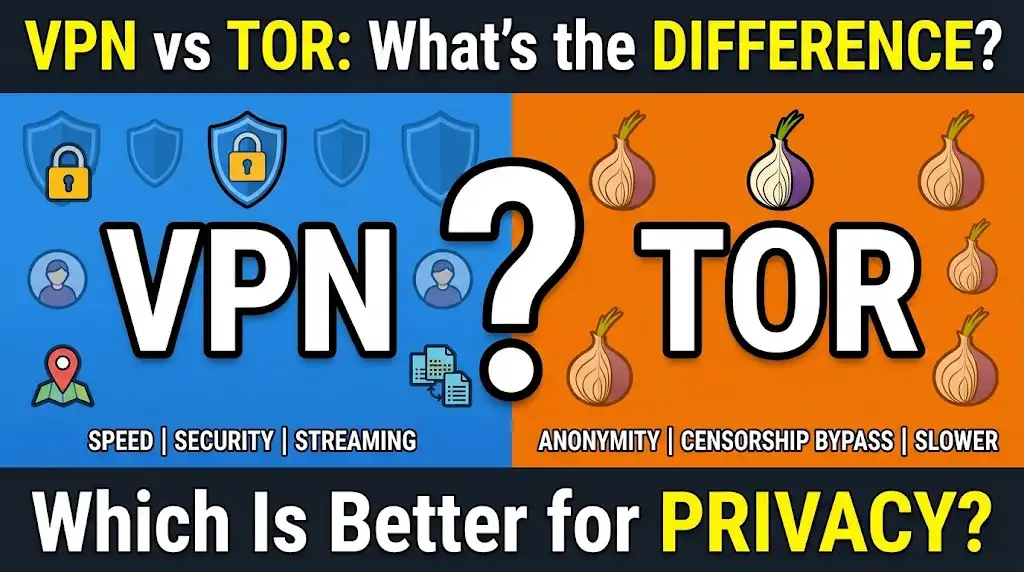
VPN vs Tor: What's the Difference? – Complete Comparison (2026)
In the world of online privacy, two tools dominate the conversation: VPN (Virtual Private Network) and Tor (The Onion Router). Both help protect your identity and data, but they work in fundamentally different ways and serve different purposes. Are they interchangeable? Not at all. In this guide, we'll break down the key differences, strengths, weaknesses, and use cases for each, so you can decide which one—or both—is right for you. Whether you're a privacy novice or a security enthusiast, this comparison will give you clarity.
What Is a VPN?
A VPN creates a secure, encrypted tunnel between your device and a VPN server operated by the VPN provider. All your internet traffic travels through this tunnel, hiding your IP address and encrypting your data from your internet service provider (ISP), Wi-Fi snoopers, and even the websites you visit (to some extent). The VPN server then connects to the internet on your behalf.
Key characteristics of a VPN:
- Encrypts all traffic from your device.
- Hides your real IP address by replacing it with the VPN server's IP.
- Provides a fixed, reliable connection with consistent speed.
- Typically run by commercial companies with clear privacy policies (though some log data).
- Easy to use: one-click connect on all devices.
What Is Tor?
Tor is a free, open-source network designed to anonymize your internet activity by routing your traffic through multiple volunteer-operated relays (or nodes). Each relay only knows the previous and next hop, not the full path, making it extremely difficult to trace back to you. The most common way to use Tor is through the Tor Browser, which is a modified Firefox browser that automatically routes your traffic through the Tor network.
Key characteristics of Tor:
- Routes traffic through at least three relays: entry, middle, and exit.
- Each relay encrypts the data layer by layer (like an onion).
- No single relay knows both the source and destination.
- Free to use, maintained by a non-profit organization.
- Slower than VPN due to multiple hops and volunteer bandwidth.
- Exit nodes can see unencrypted traffic, so HTTPS is essential.
Head-to-Head: VPN vs Tor
Quick Comparison Table
| Feature | VPN | Tor |
|---|---|---|
| Speed | Fast (minimal slowdown) | Slow (multiple relays) |
| Anonymity level | High (but provider can see your traffic) | Very high (no single point of failure) |
| Encryption | AES-256 typically, full tunnel | Layered encryption (onion), but exit node sees decrypted data |
| Ease of use | Very easy, system-wide | Requires Tor Browser; not system-wide |
| Cost | Typically paid (free ones risky) | Free |
| Best for | Daily privacy, streaming, torrenting, remote work | Maximum anonymity, bypassing deep censorship, accessing .onion sites |
| Trust model | Must trust VPN provider not to log | Trust distributed; no single entity to trust |
Key Differences Explained
1. Speed and Performance
VPNs are generally much faster than Tor. A good VPN adds only a small latency overhead (10-20%), making it suitable for streaming, gaming, and large downloads. Tor, on the other hand, routes your data through at least three random relays worldwide, resulting in noticeable slowdowns. Pages take longer to load, and large files can be painfully slow. Tor is not recommended for streaming or torrenting due to speed and network load.
2. Anonymity and Trust
With a VPN, your ISP sees only encrypted traffic to the VPN server. However, the VPN provider can see your real IP and the sites you visit. Therefore, you must trust that the VPN provider has a strict no-logs policy and doesn't share data with authorities. Tor, by contrast, distributes trust among thousands of volunteer relays. No single relay knows both who you are and what you're doing. This makes Tor more anonymous by design, but not foolproof—malicious exit nodes can still snoop on unencrypted traffic.
3. Encryption and Security
Both use strong encryption, but the model differs. A VPN encrypts the entire connection from your device to the VPN server. After that, traffic travels normally. Tor uses layered encryption: your data is encrypted three times, and each relay peels off one layer. The final exit node sees the data in plaintext if it's not HTTPS. Therefore, always use HTTPS websites even when using Tor. VPNs provide a consistent, system-wide encrypted tunnel; Tor only encrypts traffic inside the Tor Browser.
4. Ease of Use
VPNs are extremely user-friendly. You install an app, click connect, and all your traffic is protected—including email clients, games, and other apps. Tor requires you to use the Tor Browser for anonymity. Other apps on your device will not be routed through Tor unless you configure them specially. This makes VPNs more convenient for everyday, all-device privacy.
5. Cost
Tor is completely free and supported by donations. VPNs usually require a paid subscription (with some free options that often have limitations or questionable privacy). For reliable privacy, a paid VPN is recommended because free VPNs may sell your data or have weak security.
When to Use VPN vs Tor
Use a VPN when you want:
- Fast, everyday privacy on all devices.
- Secure public Wi-Fi (cafes, airports).
- Access geo-blocked streaming services (Netflix, BBC iPlayer).
- Download torrents safely.
- Work remotely with a secure connection to office networks.
- Keep your ISP from throttling or tracking your browsing.
Use Tor when you need:
- Maximum anonymity for sensitive activities (journalism, activism).
- To bypass strict censorship in countries that block VPNs.
- Access .onion sites (hidden services).
- Protect your identity from being traced back to your IP.
- Resist traffic analysis or surveillance by a determined adversary.
Can You Use Both?
Yes. Many privacy-focused users combine a VPN with Tor: they connect to a VPN first, then open Tor Browser. This setup hides Tor usage from your ISP and prevents the Tor entry node from seeing your real IP. However, it can be slower and may not always be necessary. Another approach is using Tor over VPN (VPN → Tor) or Tor over VPN (Tor → VPN) depending on your threat model. For most people, using one or the other is sufficient.
Real-World Example: Two Different Privacy Needs
Consider two users: Maria, a remote worker who wants to securely access company files and stream Netflix while traveling, and Omar, a journalist in a repressive country who needs to communicate with sources without revealing his location. Maria should use a VPN—it's fast, encrypts all her traffic, and allows access to geo-blocked content. Omar should use Tor—it provides strong anonymity and can bypass censorship that might block VPNs. Their different needs illustrate why VPN and Tor are not competitors but complementary tools for different scenarios.
Frequently Asked Questions
Is Tor better than a VPN for privacy?
Tor offers stronger anonymity because no single entity can link your activity to your identity. However, a VPN is often sufficient for everyday privacy and is much faster. For maximum anonymity, use both.
Can my ISP see that I'm using Tor or VPN?
With a VPN, your ISP sees only encrypted traffic to the VPN server, not the sites you visit. With Tor, your ISP can see that you're using Tor (unless you use a VPN first), but they cannot see your destination. Some ISPs may throttle or block Tor traffic.
Is Tor legal?
Yes, Tor is legal in most countries. However, some countries with strict censorship block Tor or make it illegal. Always check local laws before using Tor.
Can I use Tor for torrenting?
It's strongly discouraged. Tor is slow, and torrenting through Tor puts strain on the network and may leak your IP. Use a VPN for torrenting instead.
Which is faster: VPN or Tor?
VPN is significantly faster. A good VPN adds minimal overhead, while Tor routes through multiple relays causing high latency and slower speeds.
Conclusion: Choose Based on Your Threat Model
VPN and Tor serve different purposes. If you need fast, convenient privacy for daily use, streaming, or torrenting, a VPN is the right choice. If you need maximum anonymity, access to hidden services, or bypassing strict censorship, Tor is your tool. For the highest level of privacy, combine them. The key is to understand your threat model and choose the appropriate tool—or both—to keep your online activities private and secure.
Discussion (0)
No comments yet. Be the first to share your thoughts!